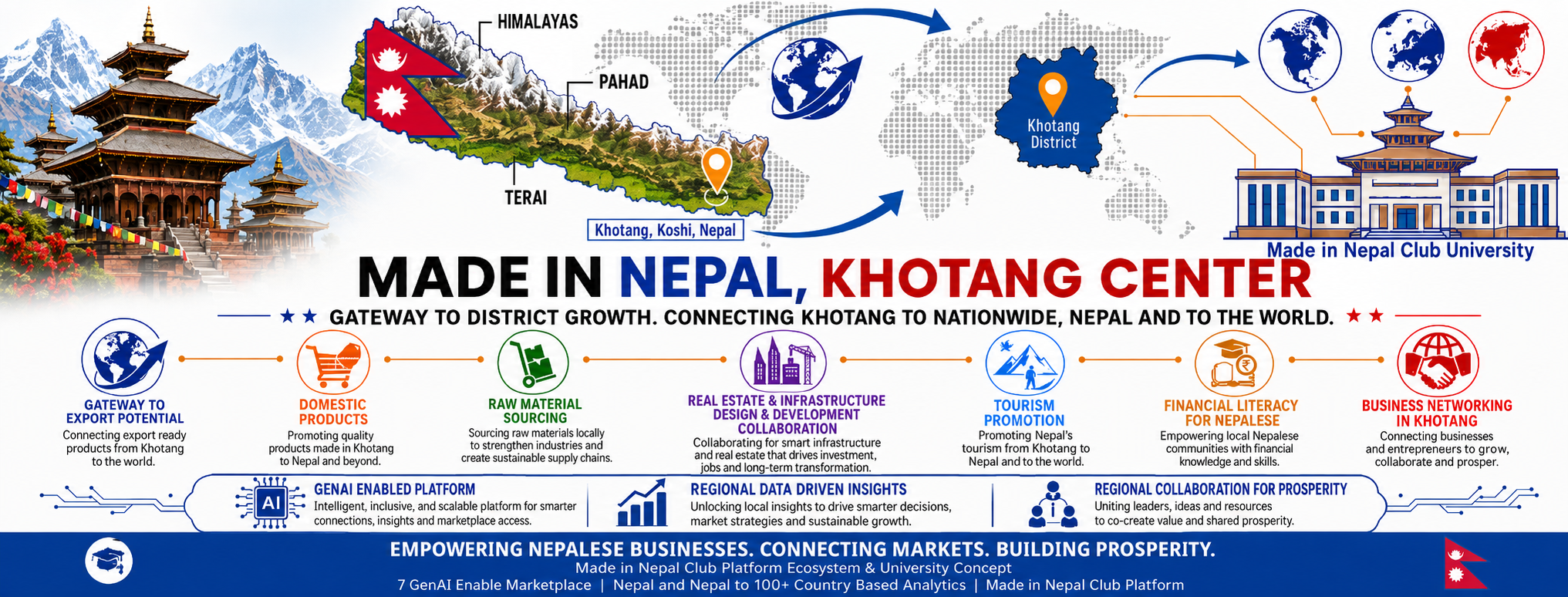
Gateway to Growth. Connecting Khotang to Nepal and the World.
VisitKhotang.com | International + Nepal Business Strategy Brief
Khotang Economic Gateway
From Pilgrimage and Hill Production to Nationwide Scale and Global Market Connectivity.
Strategic Research BriefSeptember 2026Khotang District, Koshi Province, Nepal
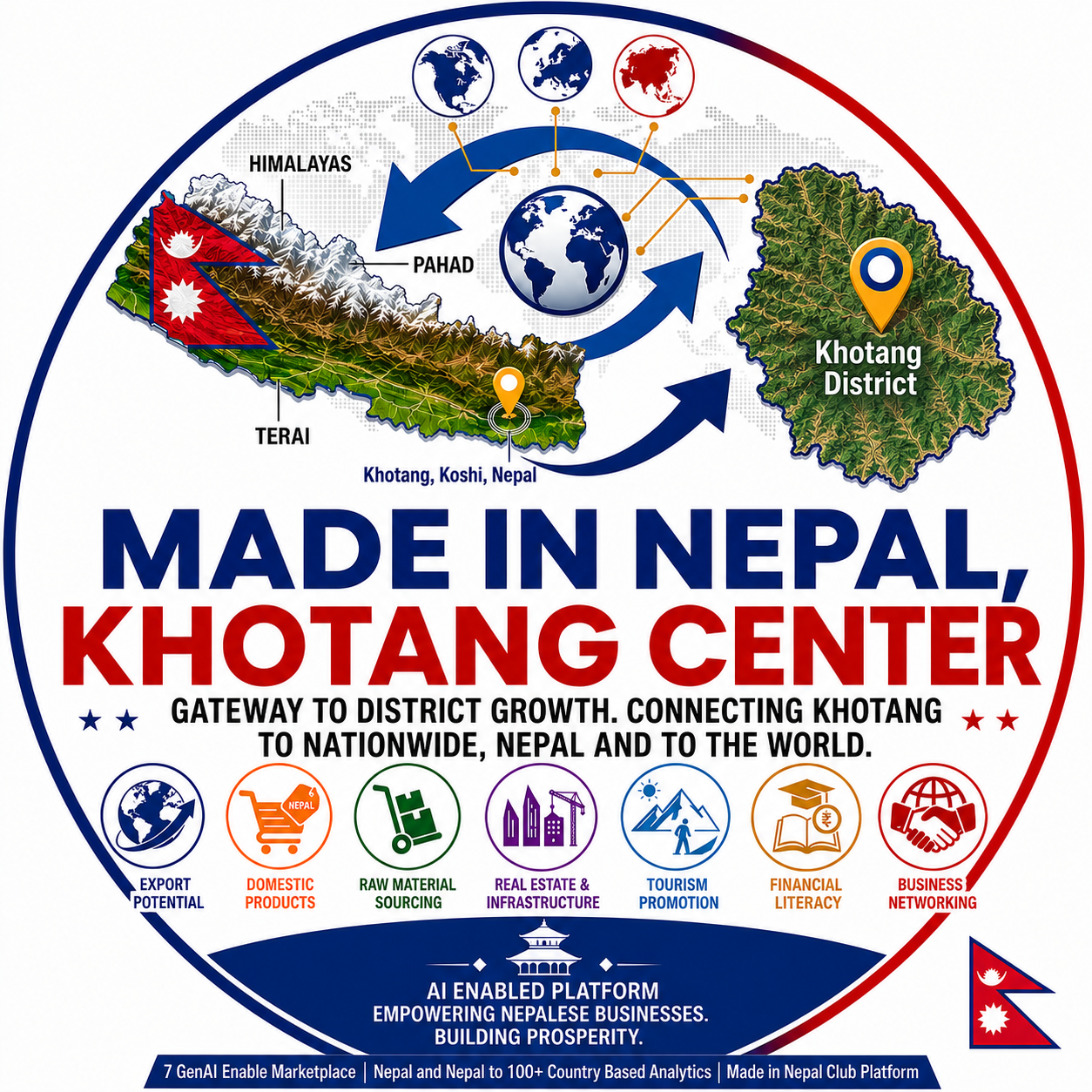
Gateway to Export Potential • Domestic Product Promotion • Raw Material Sourcing • Real Estate & Infrastructure Design & Development Collaboration • Tourism Promotion • Financial Literacy for Nepalese • Business Networking in Khotang, Nepal and to the World
One District. Three Markets. A Pilgrimage & Production Gateway.
Khotang had 175,298 residents in Nepal's 2021 census. The National Economic Census 2018 recorded 4,308 establishments engaging 11,314 people.
The district combines Halesi/Maratika pilgrimage, Diktel's service economy, large cardamom, mandarin, potato, coffee and other hill agriculture with a sizeable external population.
The strategy should link local value creation with Nepal-wide distribution and global buyers, pilgrims, diaspora, technology and investment networks.
175,298Population, 2021
4,308Economic establishments
11,207Residents abroad, 2021
358 MTLarge cardamom output
Seven Integrated Global Platforms
Benefit Khotang locally, Nepal nationally and markets globally
Every feasibility study should explicitly test the district, national and global beneficiary layers.
1. Khotang Businesses
2. Nationwide Nepal
3. Global Buyers / Pilgrims / Investors / Diaspora
1
Gateway to Export Potential
Prioritize large cardamom, mandarin/citrus, potato, coffee, ginger, hill vegetables, honey and selected processed foods. Khotang currently records about 1,125 ha under large cardamom with 358 MT output, 685 ha of mandarin with 3,422.91 MT output, and 2,570.6 ha of potato with 23,135.4 MT output. Commercialization requires aggregation, grading, processing, packaging, certification, HS-code analysis and buyer validation.
Market Research and Feasibility Study On:Gateway to Export PotentialView Market Research→
2
Domestic Product Promotion
Build a Made in Khotang identity around origin, high-hill agriculture, pilgrimage culture, Kirat heritage and trustworthy producer stories. Use verified directories, professional packaging, QR origin stories, Diktel/Halesi showcases, provincial fairs and national e-commerce before international promotion.
Three-market beneficiaries: District: producers and local markets. Nepal: Kathmandu/Koshi retail and hospitality. Global: diaspora, specialty retailers and cultural-market channels.
Market Research and Feasibility Study On:Domestic Product PromotionView Market Research→
3
Raw Material & Technology Sourcing
Focus on disease-resistant planting material, irrigation, cardamom dryers, coffee pulping/roasting, grading, cold storage, food processing, packaging, solar energy, water systems and digital tools. Source in Nepal first; use regional/global suppliers only where productivity, quality or lifecycle economics justify it.
Three-market beneficiaries: District: higher productivity and lower loss. Nepal: equipment suppliers, labs and technical institutions. Global: OEM, certification and technology partners.
Market Research and Feasibility Study On:Raw Material & Technology SourcingView Market Research→
4
Real Estate & Infrastructure Collaboration
Prioritize infrastructure linked to economic throughput: collection centers, cold storage, agro-processing, market sheds, tourism lodges, pilgrimage services, broadband, water systems, resilient roads and logistics. Diktel can strengthen as the district services hub; Halesi needs visitor-oriented hospitality and public-realm investment; CAAN lists Khanidanda and Thamkharka among domestic airports in operation, but actual schedules must be verified before commercial planning.
Three-market beneficiaries: District: MSMEs, municipalities, farmers, tourism. Nepal: developers, engineers, banks, operators. Global: diaspora and technical/investment partners for bankable projects.
Market Research and Feasibility Study On:Real Estate & Infrastructure CollaborationView Market Research→
5
Tourism Promotion — Visit Khotang
Make Halesi Mahadev/Maratika the anchor for a wider Khotang circuit. Nepal Tourism Board identifies Halesi as a major Shiva pilgrimage cave with important Buddhist connections to Padmasambhava. Pair it with Diktel, Rupakot, Majhuwagadhi, Buddheshwor cave, local Kirat culture, village stays, hill walks, agro-tourism and regional circuits.
Three-market beneficiaries: District: hotels, homestays, guides, transport and retailers. Nepal: pilgrimage/domestic tour operators. Global: Hindu/Buddhist pilgrims, cultural travelers and diaspora visitors.
Market Research and Feasibility Study On:Tourism Promotion — Visit KhotangView Market Research→
6
Financial Literacy for Nepalese
Serve farmers, cooperatives, SMEs, youth, migrant households and returnees with budgeting, bookkeeping, productive credit, insurance, digital payments, taxation awareness, remittance planning, FX risk and responsible investing. With 11,207 Khotang residents recorded abroad in 2021, diaspora financial capability should be linked to productive local enterprise and transparent investment pipelines.
Three-market beneficiaries: District: resilient households and businesses. Nepal: formal finance and entrepreneurship. Global: remittance, diaspora capital and returnee enterprise links.
Market Research and Feasibility Study On:Financial Literacy for NepaleseView Market Research→
7
Business Networking in Khotang, Nepal & the World
Use the district’s 4,308 recorded economic establishments as the starting base for a verified B2B directory. Connect farmers, processors, traders, hotels, professionals and contractors with Nepal-wide buyers, banks, exporters and institutions, then map Khotang-origin diaspora, pilgrims, importers, mentors, investors and technology providers globally.
Three-market beneficiaries: District: referrals and deal discovery. Nepal: buyers, finance and institutions. Global: diaspora, importers, tourism partners, mentors and investors.
Market Research and Feasibility Study On:Business Networking in Khotang, Nepal & the WorldView Market Research→
Pilgrimage: Nepal Tourism Board identifies Halesi Mahadev as a major Shiva pilgrimage cave with a nearby Buddhist monastery and the Maratika tradition connected to Padmasambhava. The opportunity is to extend visitor spending into lodging, food, transport, local products and multi-day circuits.
Agriculture: Current Koshi Province data report about 358 MT of large cardamom, 3,422.91 MT of mandarin and 23,135.4 MT of potato in Khotang. Coffee production is smaller but commercially interesting as a niche product.
Connectivity: Diktel Rupakot Majhuwagadhi Municipality identifies Rupakot, Majhuwagadhi, caves and Khanidanda Airport among local assets; CAAN lists Khanidanda and Thamkharka among domestic airports in operation. Actual airline schedules must be verified before packaging air-dependent products.
Diaspora: 11,207 residents recorded abroad can become buyers, mentors, investors, technology scouts and tourism ambassadors when opportunities are transparent and professionally screened.
International + Nepal Business Strategy
VisitKhotang.com should function as more than a tourism site. It can become Khotang's integrated economic gateway—linking agriculture, pilgrimage tourism, processing, infrastructure, finance, national distribution and global networks under one market-development architecture.
LOCAL VALUE CREATION + NATIONWIDE DISTRIBUTION + GLOBAL MARKET ACCESS + PILGRIMAGE TOURISM + AGRI-TECH + DIASPORA CAPITAL + B2B NETWORKS
Turning Khotang's Identity Into Measurable Economic Opportunity
VisitKhotang.com / Made in Nepal, Khotang Center can connect Khotang's farmers, processors, pilgrimage and tourism businesses, youth and entrepreneurs with Nepal's domestic economy and global buyers, visitors, investors, diaspora and technology partners.
Currency Standard: All financial figures on this platform should be displayed in Nrs and USD. For indicative conversion, this research uses the midpoint of Nepal Rastra Bank's 7 September 2026 rate: Nrs 150.88 buying and Nrs 151.48 selling, or approximately Nrs 151.18 = USD 1. Actual bank and transaction rates may differ.
Research & Information Disclaimer: This page is intended for general district economic-development, business, trade, tourism, infrastructure and financial-education information. It does not constitute legal, tax, engineering, customs, regulated financial or investment advice. Product markets, technology purchases, tourism concepts, infrastructure projects and investments should undergo current technical, regulatory, market and financial feasibility review.
Research Published by Jay Sarraf, USA, Currently in Kathmandu,Nepal , Supported by The Raj Sarraf, USA